
One Piece of Knowledge Every Piper Needs to Master

Ask a piper how to play a grip, D throw, birl, or taorluath, and they'll probably demonstrate the finger movement without hesitation.
Now ask them this:
"Where does the timing happen in the embellishment - at the start or the end?"
For many pipers, the answer isn't so clear.
And that's one of the biggest obstacles to developing truly musical piping.
Finger Movement Isn't Enough
Learning the mechanics of embellishments is only half the battle.
The other half is understanding how those embellishments fit into the rhythm of the tune.
Every embellishment occupies time.
Some begin on the beat.
Some finish on the beat.
Others lead into the beat.
If you don't know where an embellishment belongs rhythmically, you're left guessing.
Even if your fingers are technically correct, the tune can still sound rushed, uneven, or rhythmically unsettled.
Timing Isn't Random
Unfortunately, many pipers unknowingly play embellishments by feel rather than by understanding.
One time a birl is early.
The next time it's late.
A grip might be squeezed into the note one phrase and stretched out the next.
Those tiny inconsistencies may seem insignificant, but over the course of an entire tune they add up.
The result is music that never quite settles into a confident rhythm.
Rhythm Comes Before Speed
Many players focus on making embellishments faster.
But speed isn't the goal.
Rhythm is.
A correctly timed embellishment played at a moderate tempo will almost always sound better than a fast embellishment that's rhythmically misplaced.
When every embellishment consistently lands where it belongs, your entire performance becomes cleaner, more confident, and easier for others to play with.
That's especially important in a pipe band, where every player needs to interpret the rhythm the same way.
One Book That Changed My Understanding
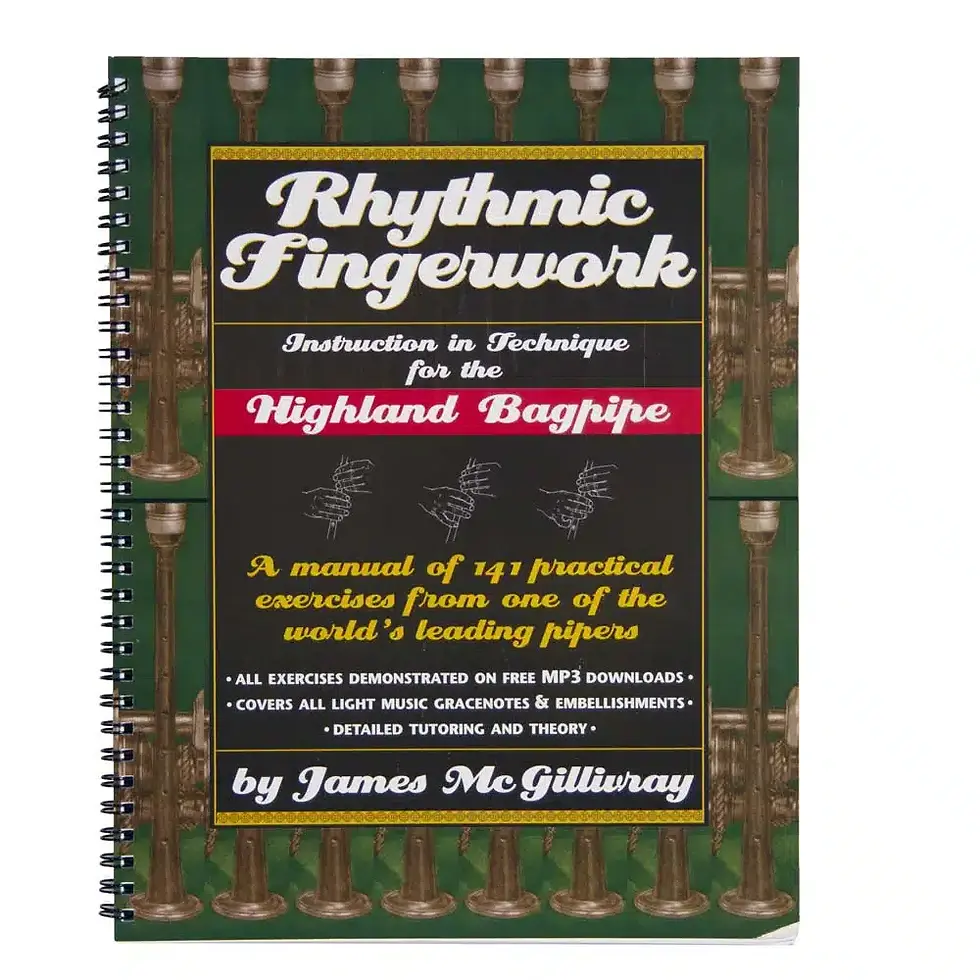
There are very few resources that explain timing as clearly as J. McGillivray's Rhythmic Fingerwork.
Adrian Melvin has long recommended this book because it helped transform not only his own playing, but also his understanding of how embellishments function within the music.
Rather than simply teaching finger movements, it explains where the embellishments fit within the rhythm of the tune and why that matters.
It's one of those books that is a turning point in your learning that makes you think differently about piping.
Many experienced pipers find themselves saying, "I wish I'd learned this years ago."
Better Timing Leads to Better Ensemble
Understanding structure of timing doesn't just improve solo playing.
It makes you a better band member.
When every piper knows exactly where embellishments begin and end relative to the beat, the entire pipe corps plays with greater precision.
The result is:
Cleaner ensemble.
Better expression.
More consistent phrasing.
Greater confidence playing with the drum corps.
Music that sounds intentional instead of accidental.
Final Thoughts
Great piping isn't just about moving your fingers quickly.
It's about understanding how every embellishment fits into the rhythm of the music.
That knowledge turns technical movements into musical expression.
If you've never studied rhythmic fingerwork in detail, J. McGillivray's Rhythmic Fingerwork is one of the best investments you can make in your piping education.
It's a book Adrian Melvin recommends to students because it provides a deeper understanding of timing, rhythm, and musical phrasing—knowledge that can improve every tune you play.
You can find Rhythmic Fingerwork by J. McGillivray at Melvin Reeds:
Happy Piping!


Comments